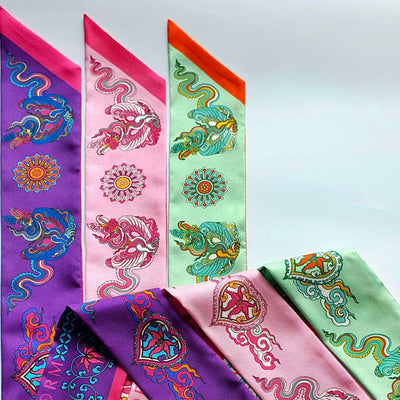
Hand Screen-Printed vs Digitally Printed Silk Scarves: How to Tell
Trang DaoQuick answer: A hand screen-printed silk scarf is colored by pushing dye through a separate mesh screen for each color, one pass at a time. A digitally printed scarf is colored by an inkjet printer working from a file, with no screens at all. Both can produce beautiful silk. You can tell them apart by color edges, gradients and the reverse face, and judge either one with the same checklist.

Lay a printed square on a table by a window and turn one corner over. The back of the silk, the line where two colors meet and the rolled edge under your thumb tell you most of what a label leaves out.
How hand screen printing on silk works
In screen printing, a fine mesh is stretched over a frame and coated so that dye passes through the open parts of the design and nowhere else. Each color in the pattern needs its own screen. The silk is pinned flat along a long printing table, and the printer sets the screen down, pulls dye across it with a squeegee, lifts it and moves to the next position. When one color is finished, the next screen goes down in register with the last, so that a red mane lands exactly inside its dark outline. A design in eight colors would need eight screens and eight separate passes over every scarf.
After printing, the silk is usually steamed to fix the dye, then washed and dried before the edges are finished. That is the process behind the line on our product pages: "Hand screen-printed through both faces, one screen for each color."
The result is flat, dense color with crisp edges, a counted palette (one hue per screen) and small differences from one scarf to the next, since every pass is pulled by hand.
How digital printing on silk works
A digital textile printer sprays microscopic droplets of dye onto the fabric and builds the image from a file, much like a desktop inkjet working on a far larger scale. The silk is usually pretreated so it accepts the dye, then steamed and washed afterward to fix the color. Since there are no screens, the number of colors is effectively open: photographic detail, soft gradients, watercolor washes and fine shading are all practical.
Setup is light, so short runs and one-off designs are affordable. That is why silk scarf custom printing services, from a pet portrait to a company logo, usually print digitally.

Hand screen-printed vs digitally printed silk: side by side
Each method suits a different kind of design; neither column is a verdict.
| Point | Hand screen printing | Digital printing |
|---|---|---|
| How color goes on | Dye pulled through a mesh screen by hand, one screen per color | Droplets of dye sprayed by a print head, guided by a file |
| Number of colors | Counted: one screen for each | Effectively open |
| Gradients and photo detail | Limited; shading is built from separate flat colors | Smooth and easy |
| Where two colors meet | Crisp edge, sometimes a hairline overlap | Soft or crisp; under magnification, fine dots |
| Setup | Heavy: screens are made and aligned before printing | Light: a file and a test print |
| Small runs and custom designs | Costly per piece | Practical |
| Reverse face | Varies with dye and fabric; check it | Varies with dye and fabric; check it |
| Scarf to scarf | Small hand-made differences | Close to identical |
A simple way to choose: for a photograph, a logo or a one-off design, digital printing is the practical route. For a gift that will be handled, knotted and turned over, a screen print with color on both faces rewards the closer look a recipient gives it the evening she wears it out.
How to tell if a silk scarf is hand printed
Good daylight and a phone camera zoomed in are enough.
- Look where colors meet. Screen printing leaves solid color right up to a clean edge, and you may see a hairline where one screen overlaps the next. Digital printing, magnified, often breaks into tiny dots, the way a photo in a magazine does.
- Count the colors. If you can name each hue and every one is a flat field, the design was probably built for screens. Hundreds of tones and photographic shading point to a digital file.
- Turn it over. Hold the silk up to a window and compare the back with the front. A print that reads strongly on both faces means the dye went well into the fibers, whichever method put it there.
- Follow the outlines to the corners. On a screen print, alignment is set by hand for each pass, so check that outlines sit on their fills evenly from the center to all four corners.
- Read the description. A maker who prints by hand usually says so plainly. The word "printed" alone could mean either method, and some makers use both across a collection, so judge each piece on its own.
Hand painting is a third method: the dye goes on with a brush, so brush marks and slight bleeds at color edges should be visible.
A checklist for judging any printed silk scarf
Whatever the method, four checks apply to every printed square, from a bandana to a shawl.
Color on both faces
Fold one corner back over the front. A deep print shows its design clearly on the reverse, so a knot or a loose drape never flashes a pale underside.
Registration edge to edge
Every outline should land on its fill across the whole square. Look hardest at the border and the corners, where small drift is easiest to see.
Color depth
Good dye work looks saturated and even, without blotches, streaks or a chalky cast. Tilt the scarf toward the light: silk should catch a soft sheen through the color.
The hem
A hand-rolled edge is round and plump, with small stitches you can see and feel, slightly irregular in spacing. A machine hem is flat and perfectly even. On our scarves, the edges are rolled and stitched by hand. For the full set of ten checks, including fiber label, weight, drape and return terms, see what makes a luxury silk scarf.

Does the print method change the price?
It changes where the cost sits. Screen printing front-loads the work in screens, mixed colors and hand passes, so the cost per scarf falls as a run grows; digital printing suits short runs. Fiber, weight and the hem weigh on price too, as we explain in why silk scarves cost what they do. If you want to see how the cloth itself is made before any dye touches it, read how silk is made, from cocoon to scarf.
Where to print a silk scarf with your own design
For a custom silk scarf in small numbers, look for a digital textile printing service that lists silk among its fabrics, often habotai, crepe de chine or twill. Before ordering, ask for the fabric weight in momme, how the edges are finished and a test print of your file on the same silk.
Screen printing makes sense for many identical scarves in a few flat colors, such as a club emblem, because the cost of the screens is shared across the run.
Check scarf print size before sending artwork. A 22 inch (55 cm) square hides most of a central image in a knot; a 36 inch (90 cm) or 44 inch (110 cm) square shows the whole design worn open. Our silk scarf size guide shows how each square sits when tied.
What a printed motif can carry
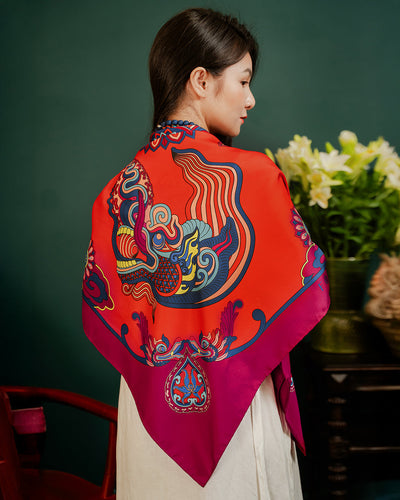
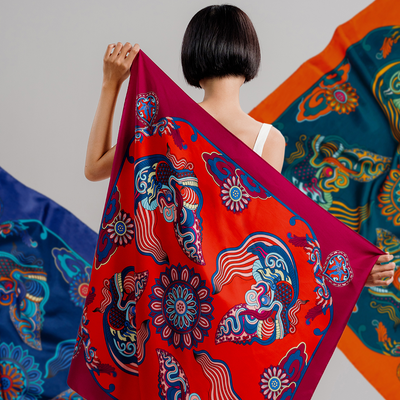
Because a screen print is built color by color, it suits motifs with strong outlines and a story worth the effort. A dragon print scarf from our Dragon Dreams collection carries the Ly dynasty dragon of the Thang Long Imperial Citadel in Hanoi: a soft body like water waves, no scales, a pearl in its mouth, the rain-bringing dragon of a rice-growing civilization. Up close you can follow each outline where one screen met the next. Folded long, a large square also sits easily at a man's collar. Read more in what Vietnamese silk motifs mean.

Frequently asked questions
Is hand screen printing better than digital printing for silk?
Each method suits different work. Screen printing gives flat, dense color in a counted palette, and digital printing handles gradients and photographic detail; judge the finished scarf by its color depth, registration, reverse face and hem.
How can I tell if my silk scarf is hand printed?
Look closely where two colors meet. Solid color to a clean edge, sometimes with a hairline overlap, suggests screens, while fine dots under magnification and smooth photographic shading suggest a digital print.
Why does the back of my printed silk scarf look lighter?
Dye does not always travel fully through the cloth, and how far it goes depends on the dye, the fabric and the printing setup. Some lightening on the reverse is common; a strong print on both faces means the dye went deep into the fibers.
Is a hand-painted silk scarf the same as a hand-printed one?
They are different methods. A hand-painted scarf is colored with a brush, so every piece differs from the next. A hand screen-printed scarf repeats one design through screens, one for each color.
How do I wash a printed silk scarf?
Use cold water and a little shampoo or body wash, do not wring, dry flat in the shade and iron on the lowest silk setting while damp. Dry cleaning is the safest choice, and our silk scarf care guide covers each step.
Browse every guide in our silk scarf and tie guides.