What Makes a Luxury Silk Scarf? A 10-Point Checklist
Dung DaoQuick answer: A luxury silk scarf is defined by things you can check: 100% silk on the label, a stated weight in momme, print that reads on both faces, a hand-rolled hem, deep and even color, a fluid drape, careful packaging, a maker who says where and how it was made, a clear care label and fair return terms. Use these ten points on any scarf, at any price.

Take the scarf to a window, turn one corner over and run the edge between finger and thumb. Within a minute, the cloth has answered most of the questions a price tag cannot.
The 10-point luxury silk scarf checklist at a glance
Each point below has its own section with more detail. Together they separate a well made silk scarf from one that simply looks expensive in a photo.
| Criterion | What to look for | How to check |
|---|---|---|
| 1. Fiber label | 100% silk, ideally mulberry silk | Read the sewn label and the product page; a burn test on a loose thread at home |
| 2. Weight | A stated weight in momme | Look for the momme figure; feel the body of the cloth |
| 3. Print on both faces | Design clearly visible on the reverse | Fold a corner back over the front in daylight |
| 4. Hem | Hand-rolled, round and plump | Run the edge between finger and thumb; look for small stitches |
| 5. Color depth | Saturated, even color, outlines in register | Check the border and all four corners |
| 6. Drape | Falls in soft folds, moves with you | Hold it up by one corner and let it hang |
| 7. Packaging | Protective box, tissue, clear card | Look at how it arrives and whether it is ready to give |
| 8. Provenance | Where the yarn comes from, where it was made, who tested it | Read the about and product pages; ask the maker |
| 9. Care label | Specific instructions for that piece | Read the label or card before any wash |
| 10. Return terms | A clear window and clear conditions | Read the returns policy before you buy |
1. The fiber label: is it real silk?
Start with the label, because everything else depends on it. A luxury silk scarf says 100% silk, and the strongest labels name the type. Mulberry silk is a natural protein fiber. The silkworm spins it from a protein called fibroin, held together by a gum called sericin that is mostly washed out during processing. Each cocoon is wound from one continuous filament that runs for hundreds of yards, which is why mulberry silk weaves into such a smooth, even cloth.
Watch the word satin. Satin is a weave, and much of what is sold as satin is polyester. Our guide to silk vs satin scarves explains how to read those labels. If you already own the scarf, a home burn test on a single loose thread helps: silk burns with a smell like burning hair and leaves a soft ash that crushes between your fingers. Polyester melts into a hard bead. Do it over a sink, away from anything flammable, and treat it as a home check. More tests are in how to tell if silk is real.
Is mulberry silk the finest silk?
Mulberry silk is the standard for fine scarves because its long, continuous filament gives a smooth, even surface and a clean ground for print. Wild silks such as tussah have a more textured surface and a natural honey tone, which suits other kinds of cloth. For a printed square, mulberry silk is the one to look for.
2. Weight: what the momme number tells you
Momme (mm) is the traditional unit of silk fabric weight. One momme equals 4.34 grams per square meter. A maker who states the momme figure is giving you a number you can compare, which is already a good sign.
Momme measures weight, and the right weight depends on the job. Lighter scarf silks knot small and float; heavier silks have more body and drape with more weight. Our scarves are 16 momme: 16 momme silk weighs about 69 grams per square meter, about 2 ounces per square yard. A 36 inch (90 cm) square at that weight comes to about 2 ounces in the hand. Read what momme means in silk for the full scale.
3. Print on both faces
A scarf is seen from both sides. In a knot, a loose drape or a hair wrap, the reverse shows as often as the front, so a pale underside breaks the effect. Fold one corner back over the front in daylight and compare the two faces. A deep print shows its design clearly on the back.
Our scarves are hand screen-printed through both faces, one screen for each color. Digital printing is another valid method with its own strengths, and you can learn to tell them apart in hand screen-printed vs digitally printed silk scarves.

4. The hem: rolled by hand
Run the edge between finger and thumb. A hand-rolled hem is round and plump, with small stitches you can see and feel, slightly irregular in spacing because a person made each one. A machine hem is flat, narrow and perfectly even. The rolled edge gives a square a soft, finished line. On our scarves, the edges are rolled and stitched by hand.
5. Color depth and registration
Good dye work looks saturated and even, without blotches, streaks or a chalky cast. Tilt the scarf toward the light: silk should carry a soft sheen through the color. Then follow the outlines to the border. In a multicolor print, every outline should land on its fill from the center to all four corners, because small drift shows most at the edges.
6. Drape and hand
Hold the scarf up by one corner and let it hang. Silk of a good weight falls in soft, rounded folds and moves when you turn. Lay it over your forearm and it should settle and follow the line of the arm. Light creasing is normal for silk and relaxes as the scarf hangs or with a low iron while damp.

7. Packaging that protects and presents
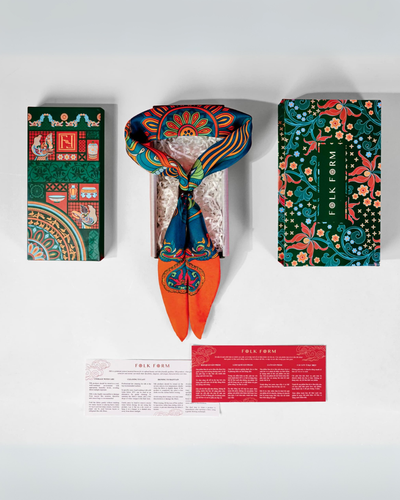
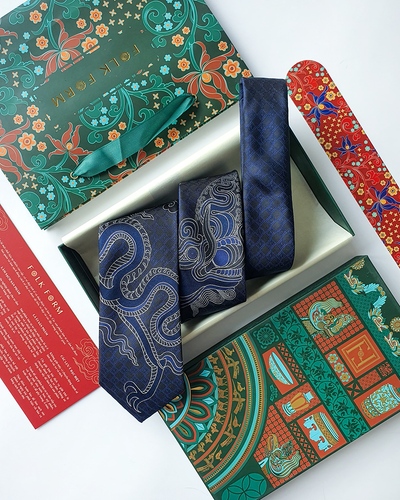
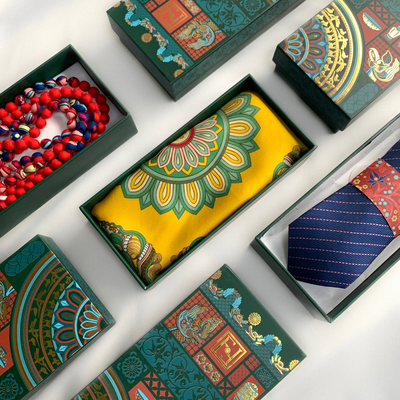
A silk scarf should arrive folded in tissue inside a firm box, so it reaches you without crushing and is ready to give. Look for a card that tells you what the design is and how to care for it. Our scarves come in a hard Folk Form box with a bag, folded in tissue, with a story card that names the motif, a guide to wearing it and a care card. For a gift, that card matters: when the tissue parts, the recipient reads why this design was chosen for her before she has even lifted the silk.

8. Provenance you can verify
A maker who stands behind a scarf tells you where the yarn comes from, where the cloth was printed and finished, and who tested it. Vague phrases about heritage are easy to write; place names and test bodies are harder to fake. Here is ours: our silk yarn comes from Hangzhou, China. Our scarves are printed in Hanoi and made in our Hanoi atelier, with edges rolled and stitched by hand. Our silk was tested at the Textile Testing Center of the Vietnam Textile Research Institute, an independent body, not our own lab.
The design deserves the same scrutiny. A heritage motif should come with a source you can follow. Our Phoenix Dance scarves, for example, carry the phoenix that served as the emblem of the empress in Vietnam's Ly and Tran dynasties, a symbol of rebirth, transformation and feminine grace, so the story on the card can be looked up by anyone who receives it.
9. A care label written for that scarf
Look for care instructions written for the specific piece. For our printed scarves: wash in cold water with a little shampoo or body wash, do not wring, dry flat in the shade and iron on the lowest silk setting while still damp. Dry cleaning is the safest choice. Skip chlorine bleach and enzyme detergents; enzymes digest protein. Long exposure to light yellows and weakens silk, so dry it in the shade and store it away from sun. Our silk scarf care guide walks through each step.
10. Return terms in plain words
A confident maker states a clear window and clear conditions before you pay. Read them before checkout, especially when buying a gift. Ours: 30 day returns for unused, unwashed, unworn items in original box.
How much is a real silk scarf?
Price follows size, because a larger square holds more silk, more print and a longer hand-rolled edge. Our squares are $75 for 22 inches (55 cm), $97 for 26 inches (65 cm), $153 for 36 inches (90 cm) and $197 for 44 inches (110 cm). A higher price does not confirm any point on this checklist by itself, which is why the ten checks matter more than the tag. For a full breakdown of the costs behind a silk scarf, read why silk scarves are expensive.
How to wear a designer silk scarf
A square silk scarf earns its price through the number of ways it can be tied. Four that cover most days:
- Neck knot (26 inch square). Lay the scarf flat, fold two opposite corners to the center, then keep folding toward the center until you have a band about 2 inches (5 cm) wide. Wrap it around the neck and tie a small square knot to one side.
- Head scarf (36 inch square). Fold the square into a triangle, place the long edge across the forehead and tie the two ends at the nape over the point.
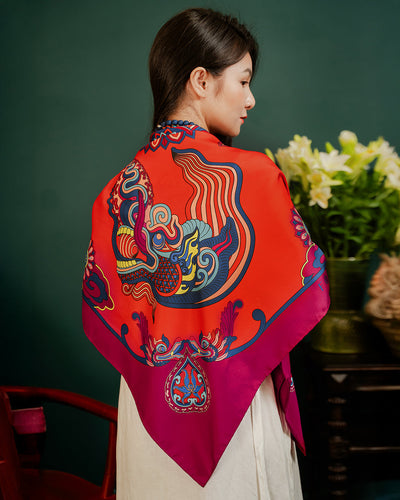
- Shoulder drape (44 inch square). Fold into a triangle, drape it over the shoulders with the point down the back, and knot the ends loosely at the chest or let them hang.
- Bag handle (22 inch square). Fold into a narrow band and wrap it around the handle, tucking each end under the last turn.
The 36 inch square covers the most ways of wearing, from a full head scarf to the shoulders. Browse our 36 inch silk scarves to see each motif at that size.

Frequently asked questions
What makes a silk scarf luxury?
Ten checkable points: a 100% silk label, a stated momme weight, print on both faces, a hand-rolled hem, deep even color, a fluid drape, protective packaging, clear provenance, a specific care label and clear return terms.
How much is a real silk scarf?
It depends on size and making. Our hand screen-printed mulberry silk squares are $75 for 22 inches, $97 for 26 inches, $153 for 36 inches and $197 for 44 inches.
Is mulberry silk the finest silk for scarves?
Mulberry silk is the standard for fine printed scarves because its long, continuous filament makes a smooth, even cloth that takes color well. Wild silks have a more textured surface suited to other uses.
Is a higher momme always better?
Momme measures weight, and the right weight depends on how the scarf is worn. Heavier silk has more body; lighter silk knots smaller and floats more.
How do I wash a fine silk scarf?
For a printed silk scarf, use cold water and a little shampoo or body wash, do not wring, dry flat in the shade and iron on the lowest silk setting while damp. Dry cleaning is the safest choice.
How do I wear a designer silk scarf?
Fold a 26 inch square into a band for a neck knot, tie a 36 inch square as a head scarf, or drape a 44 inch square over the shoulders as a triangle. A 22 inch square wraps neatly around a bag handle.
What size luxury silk scarf should I choose?
Choose 36 inches (90 cm) for the most ways of wearing, 26 inches (65 cm) for neck knots and headbands, 44 inches (110 cm) for shawls and 22 inches (55 cm) for bags, wrists and ponytails.
Browse every guide in our silk scarf and tie guides.