What Is Momme Silk? A Plain Guide to 16, 19, 22 and 30 Momme
Trang DaoQuick answer: Momme (mm) is the traditional unit of silk fabric weight. One momme equals 4.34 grams per square meter, so 19 momme silk weighs about 83 grams per square meter and 30 momme about 130. A momme number tells you how much silk is in the cloth. It says nothing about the fiber grade, the print, or how the edges were finished.

Pick up two silk scarves of the same size and the difference can be felt before it can be named: one slides through the fingers and pools on the table, the other holds a fold like paper. Momme is the number behind that difference. Once you can read it, a product listing stops being a wall of jargon and starts telling you how a piece of silk will hang, knot and feel in the hand.
What is momme in silk?
Momme is a measure of weight per area for silk fabric, written as "mm" on labels and listings. One momme equals 4.34 grams of silk in one square meter of cloth. The word comes from a traditional Japanese unit of weight, and the silk trade kept it long after metric units took over most other textiles. When a listing says "19 momme silk" or "19mm silk," it means that a square meter of that fabric weighs about 83 grams.
Think of momme the way a paper buyer thinks of paper weight. A heavier number means more material per square yard, which usually reads as more body, more opacity and a denser hand. A lighter number means a finer, more fluid cloth that moves with the air around it. Neither end of the scale is the goal in itself. The right weight depends on what the silk is going to become.
How do you pronounce momme?
It is usually said like "mommy," with the stress on the opening syllable. On labels you will more often see the abbreviation "mm."
What is momme silk made of?
Momme silk is simply silk fabric described by its weight. Mulberry silk is a natural protein fiber. The silkworm spins it from a protein called fibroin, held together by a gum called sericin that is mostly washed out during processing. The momme figure describes the woven cloth made from that fiber; it does not describe a separate kind of silk. If you want the full journey from cocoon to cloth, our guide on how silk is made, from cocoon to a hand-rolled scarf walks through each step.
Silk momme chart: weights from 8 to 30 momme
Every figure below is plain arithmetic: the momme number multiplied by 4.34 grams per square meter. The ounce figures are converted from grams and rounded, so treat them as close guides. The last column shows where each weight is commonly sold; individual makers vary.
| Momme | Arithmetic | Grams per square meter | Ounces per square yard | Where it commonly appears |
|---|---|---|---|---|
| 8 | 8 x 4.34 | about 35 | about 1.0 | Sheer chiffon, light linings |
| 12 | 12 x 4.34 | about 52 | about 1.5 | Light scarves, fine blouses |
| 16 | 16 x 4.34 | about 69 | about 2.0 | Scarves with drape, blouses |
| 19 | 19 x 4.34 | about 83 | about 2.4 | Blouses, slips, pillowcases |
| 22 | 22 x 4.34 | about 96 | about 2.8 | Pillowcases, dresses, heavier shirts |
| 25 | 25 x 4.34 | about 109 | about 3.2 | Bedding, robes |
| 30 | 30 x 4.34 | about 130 | about 3.8 | Bedding, trousers, heavier garments |
The jump from one row to the next looks small on paper. In the hand it is clear: 30 momme silk carries nearly twice the material of 16 momme silk, and you can feel that weight when the fabric drops from your fingers.
Is higher momme silk better?
Higher momme silk is heavier, and heavier is a property to match to a purpose. Momme is a weight, so it cannot tell you whether the fiber was well reeled, whether the print goes through both faces, or whether the edges were rolled by hand or run through a machine. Two scarves with the same momme can differ greatly in everything a buyer cares about once the scarf is out of the box.
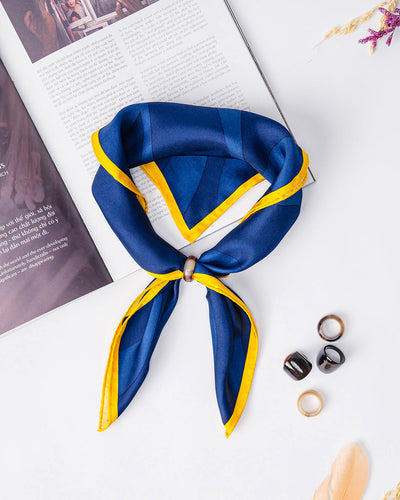
What a higher number does change is predictable. The cloth becomes more opaque, holds its shape more firmly, and costs more to make, because there is more silk in every square yard. What a lower number changes is just as predictable: the cloth becomes more fluid, more translucent in strong light, and easier to knot small. A scarf that has to sit in a neat knot at the collar and slip through a scarf ring needs that fluidity. A pillowcase or a pair of trousers needs the body that a heavier weight brings.
If the scarf is a gift, this is good news for the giver. The recipient will notice how the knot sits at her collar and how the color holds on the reverse long before she wonders about a number, so a weight in the right range plus a well made edge does more than a heavy figure on a tag.
So when a listing leans hard on a big momme number, read it the way you would read the thread count on a sheet: useful, and one fact among several. For a checklist of the other facts, see what makes a luxury silk scarf.
Is momme silk legit?
Momme is a legitimate, long-standing trade unit, and a momme number on a silk listing is a real, checkable claim about weight. The thing to check is the fiber. A momme number does not prove that the fabric is silk, so read the fiber content line on the label, which in the US must name the fiber and its percentage. Our guide on how to tell if silk is real covers the checks you can do at home.
What each common weight is good for

Is 16 momme silk good?
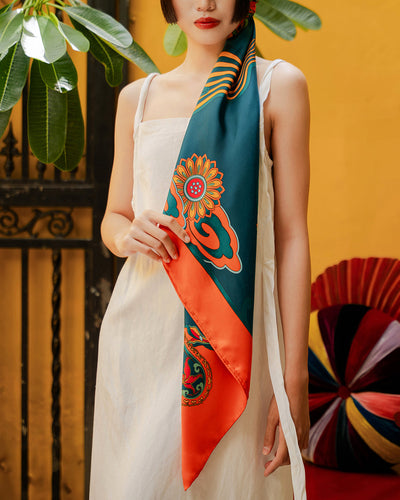
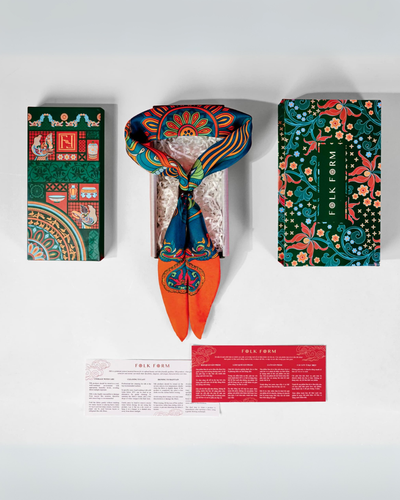
16 momme silk weighs about 69 grams per square meter, which is about 2 ounces per square yard. It is a drape weight: heavy enough to carry saturated color and hold a printed line crisply, light enough to fold into a slim band and tie in a knot that does not bulk at the throat. This is the weight we use for every Folk Form printed scarf, from the 22 inch bandana to the 44 inch shawl. On a square scarf, 16 momme means the fabric falls in soft points when you hold it by one corner and gathers neatly when you twist it into a rope.
Is 19 momme silk good?
19 momme silk is a little heavier, at about 83 grams per square meter. It is common in blouses, slips and pillowcases, where a touch more opacity matters. As a scarf it works, though the knot will be slightly fuller and the drape slightly slower.
Is 22 mm silk good?
At about 96 grams per square meter, 22 mm silk is a dense, opaque fabric with a firm hand. It appears often in pillowcases, dresses and shirts. For a large shawl it can feel substantial; for a small neck scarf it can feel stiff in the knot.
Is 25 momme silk good?
25 momme silk, about 109 grams per square meter, sits in bedding and robe territory. The extra weight gives a heavy, slow drape that suits fabric meant to lie flat or hang straight down.
Is 30 momme silk worth it?
30 momme silk, about 130 grams per square meter, is worth it when the object needs that much cloth: bedding, tailored trousers, structured garments. For a scarf, the extra weight mostly adds bulk to the knot and cost to the price. It is the right tool for a different job.
Which momme silk is right for a scarf?
For a printed square that you will knot at the neck, tie in the hair or loop through a bag handle, a weight in the mid teens gives the fold and knot you want. The size of the square matters as much as the weight, because a larger square simply contains more silk. Here is what that means for the cloth alone in each Folk Form size, before hems and ink, at 16 momme and, for comparison, at 30.
| Scarf size | Area | Cloth weight at 16 momme | Same size at 30 momme | Price |
|---|---|---|---|---|
| 22 in (55 cm) bandana | 0.30 square meters | about 21 g (0.7 oz) | about 39 g | $75 |
| 26 in (65 cm) head scarf | 0.42 square meters | about 29 g (1.0 oz) | about 55 g | $97 |
| 36 in (90 cm) hair scarf | 0.81 square meters | about 56 g (2.0 oz) | about 105 g | $153 |
| 44 in (110 cm) shawl | 1.21 square meters | about 84 g (3.0 oz) | about 158 g | $197 |
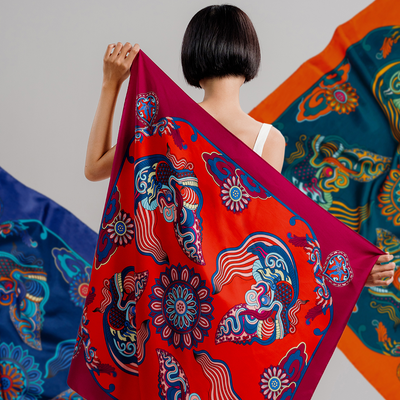
A 36 inch square at 16 momme weighs about the same as a 26 inch square at 30 momme, yet the two behave very differently: the larger, lighter square wraps the head or shoulders with soft folds, while the smaller, heavier one would sit stiffly. If size is still the open question, our silk scarf size guide shows what each square does. The 36 inch large silk hair scarves are the most versatile of the four, and a piece like the red Dragon Dreams 36 inch scarf shows how 16 momme handles a full head wrap.

Which momme for pillowcases and clothing?
For pillowcases and sheets, listings commonly sit between 19 and 25 momme, with 30 at the heavy end. Those weights give a fabric that lies flat on a pillow and resists showing every crease. For blouses, 16 to 19 momme is common because the fabric needs to move with the body. Dresses and trousers often go heavier so the cloth hangs straight.
Silk momme count, grade and rating: what each term means
Listings mix several terms that sound alike. Here is how they separate:
- Momme is the weight of the woven fabric per area. It is the number this guide is about.
- Thread count is the number of threads in a set width of cloth. It describes density of weave, and silk sellers use it less often than cotton sellers do.
- Grade refers to the raw silk thread before weaving, under grading standards for reeled silk. A grade describes the yarn; momme describes the finished cloth.
- Weave names such as satin, twill, charmeuse or habotai describe how the threads cross. A "momme silk satin" listing tells you both the weight and the weave.
When you see "silk satin momme" or "momme silk twill," read the two parts separately: the weave tells you the surface and sheen, the momme tells you the weight. Our article on silk vs satin scarves explains the weave side in detail.
How to wash silk of any momme
Care follows the product, and the weight does not change it much. For a printed silk scarf: wash in cold water with a little shampoo or body wash, do not wring, dry flat in the shade, and iron on the lowest silk setting while still damp. Dry cleaning is the safest choice. Long exposure to light yellows and weakens silk, so dry it in the shade and store it away from sun. Skip chlorine bleach and enzyme detergents; enzymes digest protein. Heavier silks take longer to dry flat, so give a 30 momme pillowcase more time than a 16 momme scarf. For more detail, read how to care for a silk scarf.

How to read a momme number before you buy
- Find the fiber line. Look for "100% silk" or "100% mulberry silk." A momme number next to a blend or a synthetic tells you little.
- Find the momme and the weave together. "16 momme twill" and "16 momme satin" weigh the same and look different.
- Match the weight to the object. Mid-teens for knotted scarves and blouses, higher for bedding and tailored pieces.
- Check the finishing. Rolled and hand-stitched edges, print that reads on both faces, and clean color at the hem tell you more about the maker than the momme does.
- Do the arithmetic. Multiply momme by 4.34 to get grams per square meter, then by the area of the piece to estimate the cloth weight.
Frequently asked questions
What does momme mean in silk?
Momme is the traditional unit of silk fabric weight. One momme equals 4.34 grams per square meter, so the number tells you how much silk is in the cloth.
Is a higher momme always better?
A higher momme is heavier and more opaque, which suits bedding and structured garments. For a scarf that needs to knot and drape, a weight in the mid teens usually handles better.
What momme silk is used for scarves?
Many silk scarves sit between 12 and 19 momme. Folk Form printed scarves are 16 momme, which weighs about 69 grams per square meter.
What momme is a silk pillowcase?
Silk pillowcases are commonly sold between 19 and 25 momme, with some at 30. The heavier weights give a fabric that lies flat and holds its shape on a pillow.
Is momme the same as thread count?
Momme measures fabric weight per area, while thread count measures how many threads sit in a set width of cloth. They describe different things and cannot be converted into each other.
How do I convert momme to grams per square meter?
Multiply the momme number by 4.34. For example, 19 momme is about 83 grams per square meter and 25 momme is about 109.
Does a high momme number prove a scarf is real silk?
A momme number describes weight alone. Confirm "100% silk" on the fiber line, then check the edge and the print; our guide on telling real silk at home covers the rest.
Browse every guide in our silk scarf and tie guides.