Why Are Silk Scarves So Expensive? What You Are Actually Paying For
Minchu NguyenQuick answer: Silk scarves are expensive because every stage is slow and hands-on: cocoons are reeled into fine thread, the thread is woven to a set weight, each color is printed separately, and the edges are rolled by hand. Inspection, packaging, shipping and import duty come on top. Our own squares run from $75 for a 22 inch bandana to $197 for a 44 inch shawl.

Unfold a 44 inch silk square across a bed and it settles in one slow wave, light enough to lift with two fingers. Most of what you pay for is the time it took to get that light.
What you are paying for in a silk scarf
Seven costs stack up between a cocoon and your door. Some are visible in the cloth; others sit in the box and the shipping label.
The fiber
Mulberry silk is a natural protein fiber. The silkworm spins it from a protein called fibroin, held together by a gum called sericin that is mostly washed out during processing. Each cocoon is wound from one continuous filament that runs for hundreds of yards, and several filaments are reeled together to make a thread strong enough to weave. That reeling is careful, slow work, and it is the base cost of every real silk scarf. Our yarn comes from Hangzhou, China, and our scarves are made in our Hanoi atelier.
The weight
Momme (mm) is the traditional unit of silk fabric weight. One momme equals 4.34 grams per square meter. Heavier silk uses more fiber per scarf, so price climbs with weight as well as size. Our scarves are 16 momme: 16 momme silk weighs about 69 grams per square meter, about 2 ounces per square yard. More on what those numbers mean in our buyer's guide to mulberry silk.
The print
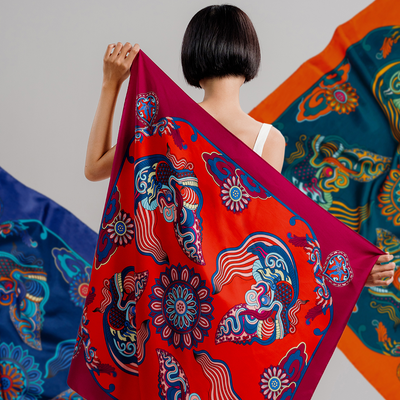
In hand screen printing, every color needs its own screen and its own pass over each scarf, and each screen has to land in register with the last. Our scarves are hand screen-printed through both faces, one screen for each color. Digital printing has a lighter setup and suits other kinds of design; we compare the two in hand screen-printed vs digitally printed silk scarves.
The hem
A hand-rolled hem is rolled tight between the fingers and stitched with small, close stitches along every side. On a 36 inch square, that is 144 inches of edge. Our edges are rolled and stitched by hand, and you can feel the plump, rounded line under your thumb.
Finishing
After printing, silk is usually steamed to fix the dye, washed, dried and pressed before it is folded into tissue.
Packaging
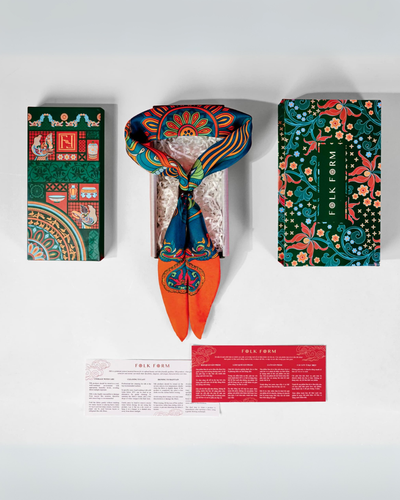
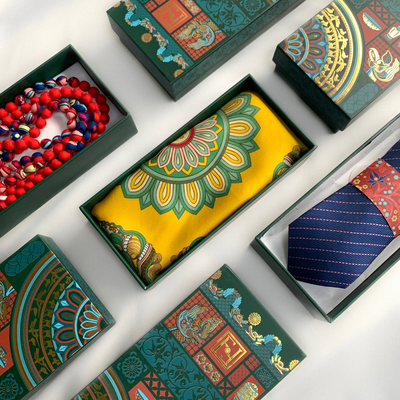
Each scarf ships in a hard Folk Form box with a bag, folded in tissue, with a story card naming the motif, a guide to wearing it and a care card.
Shipping and import duty
A scarf made abroad travels by air and is charged US import duty on arrival. Some sellers pass that charge to the buyer at the door. We pay US import duty, so the price at checkout is the price you pay.

| Cost driver | What it involves | Why it adds cost |
|---|---|---|
| Fiber | Cocoons reeled into continuous filament thread | Slow, skilled reeling of a natural protein fiber |
| Weight | Grams of silk per square meter (momme) | More silk in every square inch |
| One screen and one hand pass per color | Screen making, color mixing, alignment | |
| Hem | Edges rolled and stitched by hand | Hand time on every side of every scarf |
| Finishing | Steaming, washing, pressing | Extra handling of each piece |
| Packaging | Hard box, tissue, cards | Materials and assembly |
| Shipping and duty | Air freight and US import duty | Paid per parcel |
How much does a real silk scarf cost?
Price follows size, because a larger square holds more silk, more print and a longer hand-rolled edge. Here is our ladder, with approximate weights for 16 momme silk.
| Size | Approximate weight | Price | Worn as |
|---|---|---|---|
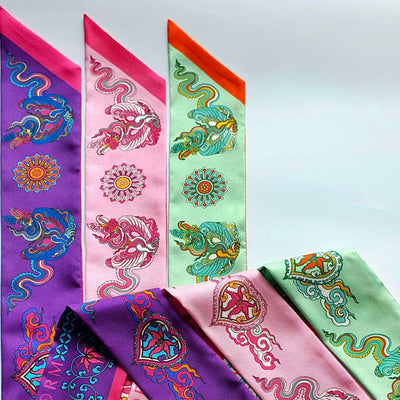
| Twilly (skinny scarf) | A few grams | $57 | Bag handle, wrist, ponytail |
| 22 inch (55 cm) square | About 21 g (0.7 oz) | $75 | Bag handle, wrist, ponytail, small neck knot |
| 26 inch (65 cm) square | About 29 g (1 oz) | $97 | Headband, hair tie, neck knot |
| 36 inch (90 cm) square | About 56 g (2 oz) | $153 | Full head scarf, neck, shoulders |
| 44 inch (110 cm) square | About 84 g (3 oz) | $197 | Shawl, wrap, large drape |
For a wider view of what different budgets buy, see luxury silk scarves under $200.
Is a silk scarf worth it?
Think in wears, since a scarf is bought once and worn for years. A 36 inch square at $153, worn twice a month for three years, comes to a little over two dollars a wear. Worn weekly, it comes to about a dollar a wear. For a gift, the same math belongs to the recipient: a scarf she ties on for ordinary Tuesdays keeps returning the thought behind it.
Start from the scarf that would do the most for you, often the 36 inch, then size down to what fits the way you dress. A 26 inch square at $97 covers headbands and neck knots, and a 22 inch silk bandana at $75 lives on a bag handle or a wrist. If the scarf marks something specific, such as a promotion, a finished degree or a year you are proud of, our silk gifts for yourself are chosen with that moment in mind.

When a silk scarf is the wrong buy
Restraint saves more money than any sale. Skip silk if you want something to toss in the washing machine, since printed silk asks for cold water, a little shampoo or body wash, no wringing, drying flat in the shade and ironing on the lowest silk setting while damp, with dry cleaning the safest choice. Skip it if the scarf would sit in a drawer, or if you want a novelty print for one costume party. Buy it when you will reach for it on ordinary days and keep it for years.
Cheap silk scarves: what to check
A very low price on a "silk" scarf usually means the fiber is something else. Satin is a weave, and much of it is polyester. Read the fiber label for 100% silk, look for a hand-rolled edge, and if you own the scarf, try a burn test on a single loose thread. Silk burns with a smell like burning hair and leaves a soft ash that crushes between your fingers. Polyester melts into a hard bead. Do it over a sink, away from anything flammable; it is a home check, and a lab report carries more weight. Our guide on how to tell if silk is real covers more tests, and what makes a luxury silk scarf gives a ten-point checklist.

Frequently asked questions
Are silk scarves expensive?
Real silk scarves cost more than polyester because of reeled fiber, weight, printing, hand-rolled hems and finishing. Ours run from $75 for a 22 inch square to $197 for a 44 inch shawl.
Is real silk worth it?
It is worth it when you will wear it often and care for it gently. Divided across a few years of regular wear, a silk square usually costs a few dollars a wear or less.
Is mulberry silk expensive?
Mulberry silk costs more than synthetic fibers because it is reeled from cocoons as long continuous filament. Price then rises with weight in momme and with the size of the scarf.
Is 30 momme silk worth it?
Momme measures weight, so 30 momme silk is heavier, at about 130 grams per square meter, and uses more fiber. Whether it suits you depends on use: a heavier cloth drapes and knots differently from a lighter scarf silk.
Which scarf size gives the most for the money?
The 36 inch square at $153 covers the widest range of ways to wear: a full head scarf, a neck knot or a drape over the shoulders. The 26 inch square at $97 is the step down for headbands and neck knots.
Why does a silk twilly cost less than a square?
A twilly is a narrow strip that uses far less silk and a shorter hand-rolled edge than a square. Ours is $57.
Browse every guide in our silk scarf and tie guides.