Handmade Silk Accessories for a Slow Fashion Wardrobe: What to Look For
Trinh HaiQuick answer: A slow fashion accessory is one you wear for years, not one season. Handmade silk fits that test when the fiber is real, the edge is finished by hand and the print shows on both faces. Start with one 26 inch (65 cm) square, which works at the neck, in the hair and on a bag.
How many of your accessories did you actually wear this month? A few pieces get worn every week. Most were bought for one event and have not moved since. Slow fashion is simply the habit of buying the first kind, and this guide shows how to spot it in silk.
It covers what the term means for ties and scarves and how Folk Form makes them. It also shows how to check any silk before you buy, and how to care for it. Prices and sizes below come from our store today.
In this guide: What it means · Why silk · How it is made · How to check · How to wear it · Care · FAQ
What is a slow fashion accessory?
A slow fashion accessory is a small piece made with enough care that you keep wearing it. It is judged by use, not by trend. The test is simple: will you still reach for it in five years?
Accessories are a practical place to begin. A tie, a silk scarf or a pocket square changes how an outfit reads without replacing a single garment. One good piece can sit over a plain coat, a white shirt or a work blazer for years.
That is why we measure by wears, not by price. A $97 scarf worn fifty times costs about $2 a wear. A cheaper piece worn twice costs far more per use, whatever the tag says.
Why silk for a slow wardrobe?
Silk is a natural protein fiber, spun by the silkworm into one long filament. Folk Form uses 100% mulberry silk, the cultivated silk most scarves and ties are woven from. Because it is a long filament, the cloth drapes and holds a rolled edge.
Our scarves are cut from 16 momme silk. Momme is the weight unit for silk cloth, and 1 momme equals about 4.34 grams per square meter (momme explained). So 16 momme is roughly 69 g/m². We state the grade and weight as supplier-specified: the fiber is graded 5A by our silk supplier, and these are not lab results.
Polyester can copy the shine in a photo. It cannot copy the way real silk falls in one piece when you tie it. That difference is the reason a silk scarf keeps its place on the shelf.

How are handmade silk accessories made at Folk Form?
Scarves and ties are made differently. A scarf is printed. A tie is woven. Both draw on Vietnamese heritage motifs, such as the Ly Dynasty dragon, drawn from objects of the Ly and Tran dynasties.
| Detail | Silk scarf | Silk tie |
|---|---|---|
| How the pattern is made | Hand screen-printed through both faces | Jacquard woven, so the motif is part of the cloth |
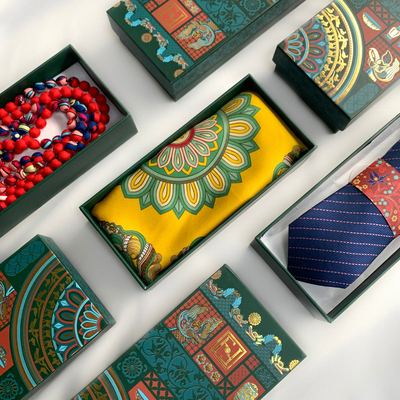
| Finishing | Edges rolled and stitched by hand | Sold with matching cufflinks as a boxed set |
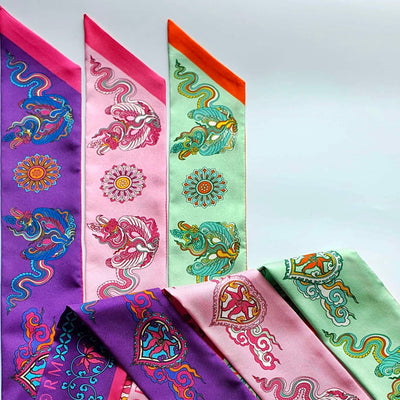
| Sizes | 22, 26, 36 and 44 inch squares; twilly 2.6 x 59 in (6.5 x 150 cm) | 3.1 x 57 in (8 x 145 cm) |
| Care | Dry clean first; or cool hand wash, dry in shade | Dry clean only |
| Price today | $57 to $197 | $167 tie; $191 to $224 tie and cufflink set |
The hem shows the work. On a 26 inch square the hand-rolled edge runs about 8.7 feet. A 36 inch square carries about 12 feet of edge, which is why the price steps up with size.

How can you tell handmade silk from a lookalike?
You can check four things in about a minute, in a shop or on arrival. None needs equipment.
- The edge. A hand-rolled hem is slightly plump and not perfectly flat. A flat, uniform hem is machine work.
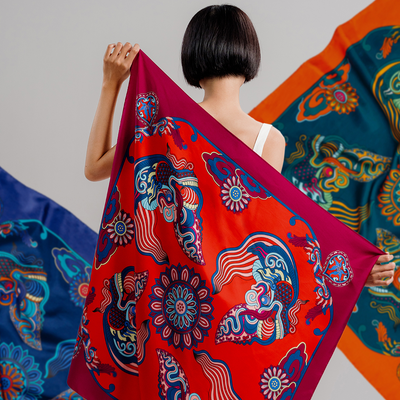
- The back. Turn the scarf over. Printed through both faces, the design shows on the reverse, so a knot never reveals a pale side.
- The weight. Ask for the momme figure. A seller who cannot state it, or the fiber, has told you something.
- The burn test. Silk burns like singed hair and leaves soft ash that crushes between your fingers. Polyester melts into a hard bead.
Every Folk Form scarf arrives with a small cutting of the same silk for that test. Do it over a sink, away from anything that can catch, with no children in the room. It is a home check, not lab proof.
For lab proof, three prints carry thread-density reports from the Textile Testing Center in Vietnam. They follow ISO 7211-2 and are dated May 2025. The prints are purple Phoenix Dance, pink Phoenix Dance and an orange dragon. The purple Phoenix print counts 512 warp and 424 weft threads per 10 cm. The reports cover only the 30 x 30 cm samples tested, so we cite them for those prints and no others.

How many ways can one piece be worn?
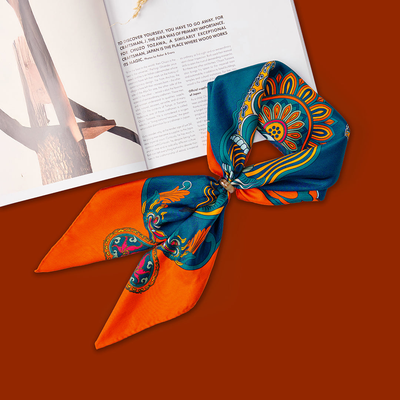
A slow piece earns its place by doing several jobs. A 26 inch (65 cm) square folds into a neck band, a headband, a ponytail wrap or a roll around a bag handle. A 22 inch (55 cm) square suits a wrist or a bag. A 44 inch (110 cm) square opens into a shawl.
A tie is narrower in purpose, but it carries more of the story. A woven dragon tie in crimson or a dotted navy one pairs with a charcoal or navy suit for years. Cufflinks need a double (French) cuff, so check his shirts first. If they close with buttons, the tie alone is the better gift.
Our size guide explains which square suits which wearer: silk scarf size guide. To see every square, browse silk scarves or silk neckties.

Our pick for slow fashion, if you are unsure
Choose the 26 inch (65 cm) silk scarf at $97. It is the size that works at the neck and in the hair, so it gets worn most. It is also the one people who have never owned silk start with. At about $2 a wear over fifty wears, it is the easiest piece in this guide to justify, and it fits a bag handle or a ponytail as readily as a collar.
Budget settles the rest. The twilly at $57 is the gentlest way to try a hand-rolled hem, though it sits below our $90 free shipping line. The 26 inch squares clear it on their own and arrive with import duty already paid. Since you have read this far, code BLOG5 will take 5% off at checkout.
How do you care for silk so it lasts?
Dry cleaning is the first choice; or hand wash in cool water with a little shampoo, do not soak, wring or rub, dry in the shade, iron on the reverse while damp on low heat. Keep silk away from perfume and cosmetics, which can mark it.
Keep ties on a smooth rail or rolled loosely, and send them to a dry cleaner when they are stained. Our guide covers the steps: how to care for a silk scarf.
What is the honest limit of slow fashion in silk?
Silk is not a perfect answer, and we do not claim it is. It takes water, land and energy to produce, like any natural fiber, and we hold no sustainability certification to cite. It also needs gentler care than a cotton scarf. If you want something you can machine wash, silk is the wrong choice.
What we can say plainly is narrower. The fiber is real, the hem is made by hand, and the piece is built to be worn for years. That is a fair basis for buying fewer things.
Answers for Handmade Silk Accessories for a Slow Fashion Wardrobe
What are slow fashion accessories?
They are pieces made with real materials and careful finishing, bought to be worn for years. A silk scarf, a tie or a pocket square all qualify when the fiber is genuine and the finish holds up to repeated wear.
Are handmade silk accessories worth the price?
They are when you wear them often. A 26 inch silk scarf at $97 worn fifty times costs about $2 a wear. The price only looks high if the piece stays on the shelf.
How can you tell if a silk tie is woven or printed?
Look at the back. On a woven jacquard tie the pattern appears in the cloth itself, with its colors reversed on the reverse. On a printed tie the back is usually paler. Folk Form ties are woven.
Can you wash a handmade silk scarf?
Dry cleaning is the first choice; or hand wash in cool water with a little shampoo, do not soak, wring or rub, dry in the shade, iron on the reverse while damp on low heat. Ties should go to a dry cleaner.
What does 16 momme mean?
It is the weight of the silk cloth. 16 momme is about 69 grams per square meter. Folk Form lists it as supplier-specified.
Does silk last as long as cotton?
Silk is a strong fiber, but sunlight and rough washing wear it faster. Kept in shade and washed gently, a silk scarf can be worn for many years.